Process & Artwork
How your gear gets made.
What dye sublimation is, why we use it, what we need from you, and what happens between your first message and a box arriving.
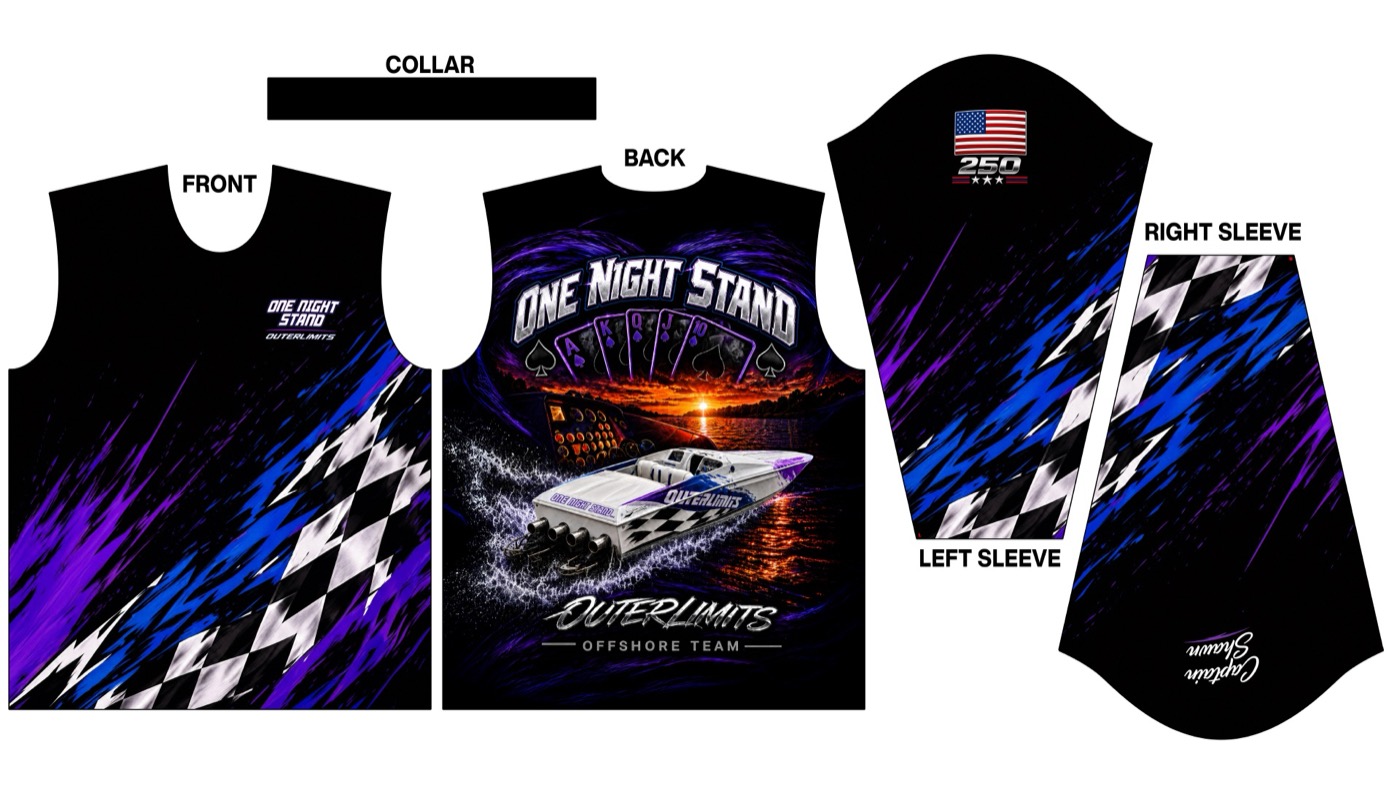
The Method
Dye sublimation,
in plain terms.
Your design is printed onto transfer paper using solid dyes. Paper and garment go through a heat press together, and under heat and pressure those dyes turn straight from solid to gas without becoming liquid - that phase change is what "sublimation" refers to.
The gas passes into the fibers of the fabric and sets there as it cools. The color becomes part of the material rather than a coating sitting on top of it. Run your hand across a finished piece and you can't feel where the print is.
That single property is where every practical advantage comes from - and also where the limitations come from, which are worth knowing before you design anything.
Compared
Sublimation, screen print,
and vinyl.
All three have their place. Here is where each one wins, so you can tell whether we're the right fit for what you want.
| Dye sublimation (ours) | Screen print | Heat-transfer vinyl | |
|---|---|---|---|
| Cost of extra colors | None - one pass prints everything | Charged per color, per screen | Each color is a separate cut and weed |
| Photographs & gradients | Straightforward | Difficult, needs halftones | Not practical |
| Coverage | Edge to edge, over seams | Limited to the screen area | Small placements and lettering |
| Feel on the garment | None - nothing sits on top | Noticeable printed panel | Distinctly plasticky patch |
| How it ages | Fades only as the fabric fades | Can crack over time | Peels and lifts at the edges |
| Works on cotton | No - needs polyester-rich fabric | Yes | Yes |
| Works on dark garments | Prints onto white or light base fabric | Yes, with an underbase | Yes |
| Best suited to | Full-coverage team gear, per-person names and numbers | High volumes of a simple logo | One-offs and small lettering |
The short version: if you want a bold, full-coverage design across a team in mixed sizes, sublimation is hard to beat. If you want a single-color logo on five hundred cotton tees, screen printing is the better call and we'll tell you so.
Artwork
What to send us
Send whatever you have. None of this is a barrier to getting started - it just changes how much work happens before your first proof.
Vector files
AI, EPS, PDF or SVG. Vector artwork is drawn as shapes rather than pixels, so it scales to any size without softening. A logo supplied as vector can go on a sleeve badge and a full back panel from the same file. If your designer made your logo, they'll have this.
High-resolution images
PNG, JPG, TIFF or PSD, as large as you have. Print needs far more detail than a screen does - an image that looks sharp on a phone is often nowhere near enough at jersey size. Layered files are welcome; we can work with the parts separately.
Whatever you've got
A photo of last season's shirt. A screenshot from social media. A sketch on paper. We'll tell you honestly whether it can be used as-is, cleaned up, or needs redrawing - and what that involves before you commit to anything.
Color will shift slightly
Screens emit light, fabric reflects it, so a color on your monitor and the same color on a jersey never match exactly. If a sponsor has a strict brand color, give us the reference and flag it - that's a normal request and worth flagging early.
Before you send it over
- Send the original, not a copy of a copy. A logo pulled from a website has usually been compressed several times. Ask whoever made it for the source file.
- Include every sponsor separately. Individual logo files let us place and scale each one properly, instead of cutting them out of a photograph of last year's gear.
- Tell us what can't change. Some sponsor agreements specify size or position. We'd rather know up front than redo a proof.
- Say what the design has to survive. A name across the shoulders reads very differently from one across the chest once someone is sitting in a boat.
- Send your names and numbers as text. A spreadsheet or a plain list, not a photo of a handwritten sheet - it removes a whole category of spelling mistakes.
- Large files? Send a link. Share your artwork through Google Drive or Dropbox and there's no file size limit. Set the link so anyone with it can view.
- Aim for 300 DPI at print size. For a full front panel, about 15 × 20 inches, that's roughly 4,500 × 6,000 pixels. We can often work from 150 DPI; below that we'll tell you before the proof.
- No artwork? Our design team can build it. Shirt graphics, logo work, or reworking something you already have, all in-house. Ask about design package pricing and we'll email it over.
Start To Finish
Four steps to your gear
-
Tell us what you need
Pieces, rough numbers, sizes if you have them, and your artwork. If you're missing something we'll tell you what and why.
-
We design your proof
Your artwork laid out on the actual garment shapes, showing exactly what prints where - including per-person names and numbers.
-
You approve it
Review your proof and request any included revisions. Nothing is printed until you've signed off, because a sublimated garment can't be undone once it's pressed.
-
We print and ship
To you, or straight to the track if you're racing before you get home. Tell us up front if it's going somewhere other than your address.
Design comes back within 7 days. After you sign off on the artwork and place the final order, production and shipping take another 2–3 weeks.
Get Started
Send us what
you have.
Even a rough idea is enough to start. We'll tell you what's missing.
Start your orderNo commitment. No payment required to get started.